Where Teens Turn for Healthy Relationship Information: What We’ve Learned from Youth this Year
It’s hard to believe that we are at the end of our five-year PREIS evaluation of the SafeSpace app! Throughout this time, we delivered the completely asynchronous digital teen pregnancy prevention intervention to over 1,000 youth. In this final year, our efforts have shifted to understand the best way to scale and disseminate SafeSpace to teens nationally.
In April 2026, MyHealthEd, Inc. had the opportunity to add five questions to the AmeriSpeak Teen Omnibus survey, a nationally representative survey that is distributed quarterly to teens between 13-17 years old. The survey, administered by NORC, covers topics such as teens’ public opinions, consumer habits, media consumption, and school experiences. The Teen Omnibus survey also collects data on teens’ age, sex, parental education, race/ethnicity, household income, and region. Our team developed questions about teens’ preferences and behaviors for seeking information about healthy romantic relationships. The insights gathered from the 1,017 youth respondents will help to inform the next steps for SafeSpace and contribute to adolescent health literature.
Below we share our five survey questions and key findings from the young people who participated. To start off, we wanted to get a general sense of where teens are most likely to seek out information about healthy relationships.
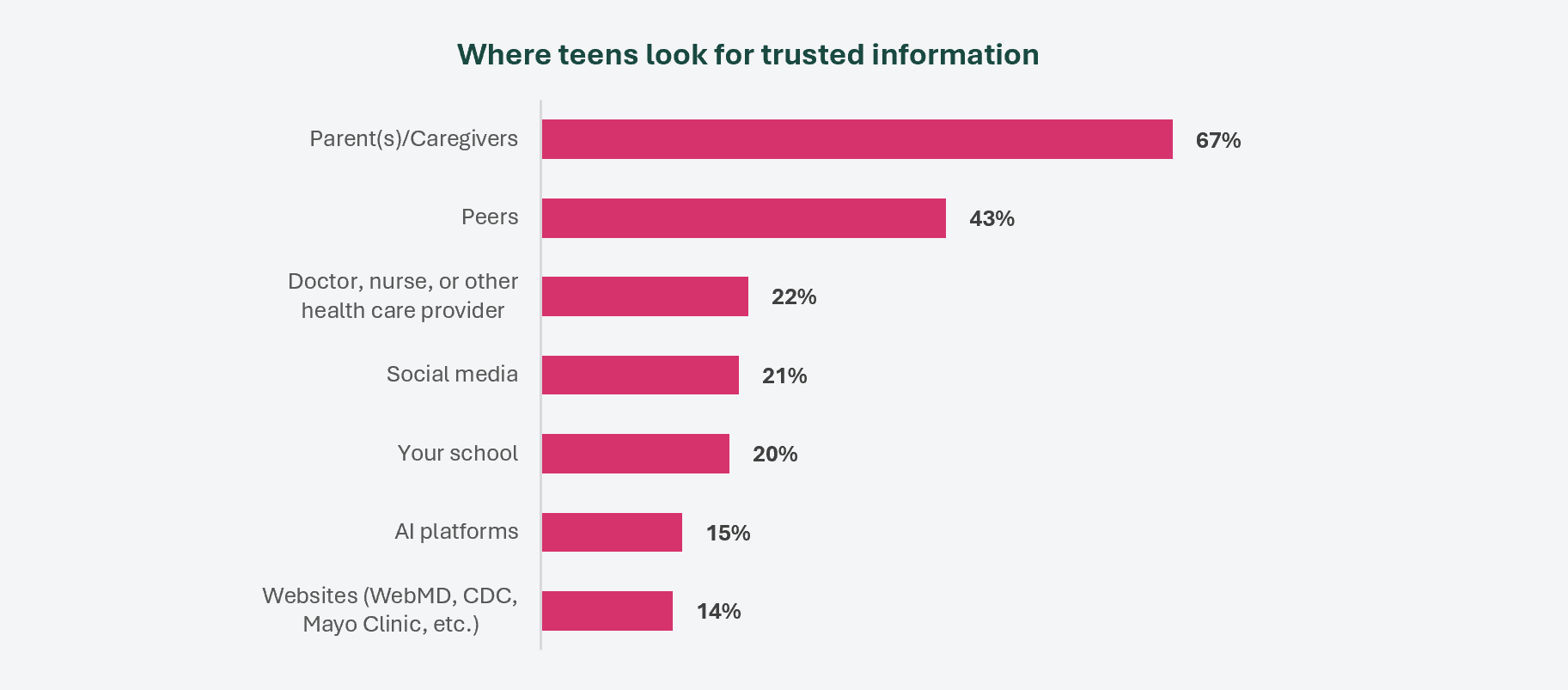
Question 1. “Where would you look for trusted information on healthy romantic relationships?”
67% of youth reported parents and caregivers as the top source, however this differed according to parents’ educational attainment. Teens whose parents had a bachelor’s degree or higher reported a significantly higher desire to turn to parents/caregivers for information about healthy romantic relationships compared to youth whose parents did not have a high school diploma, 75% and 53%, respectively.
The second most trusted place for teens to get information was from peers (43%).
23% of Black teens and 20% of those from lower-income households cited AI platforms as a trusted source.
We know that youth experience an array of barriers when it comes to getting trusted information about healthy relationships, so we wanted to ask which are most pertinent to youth today.
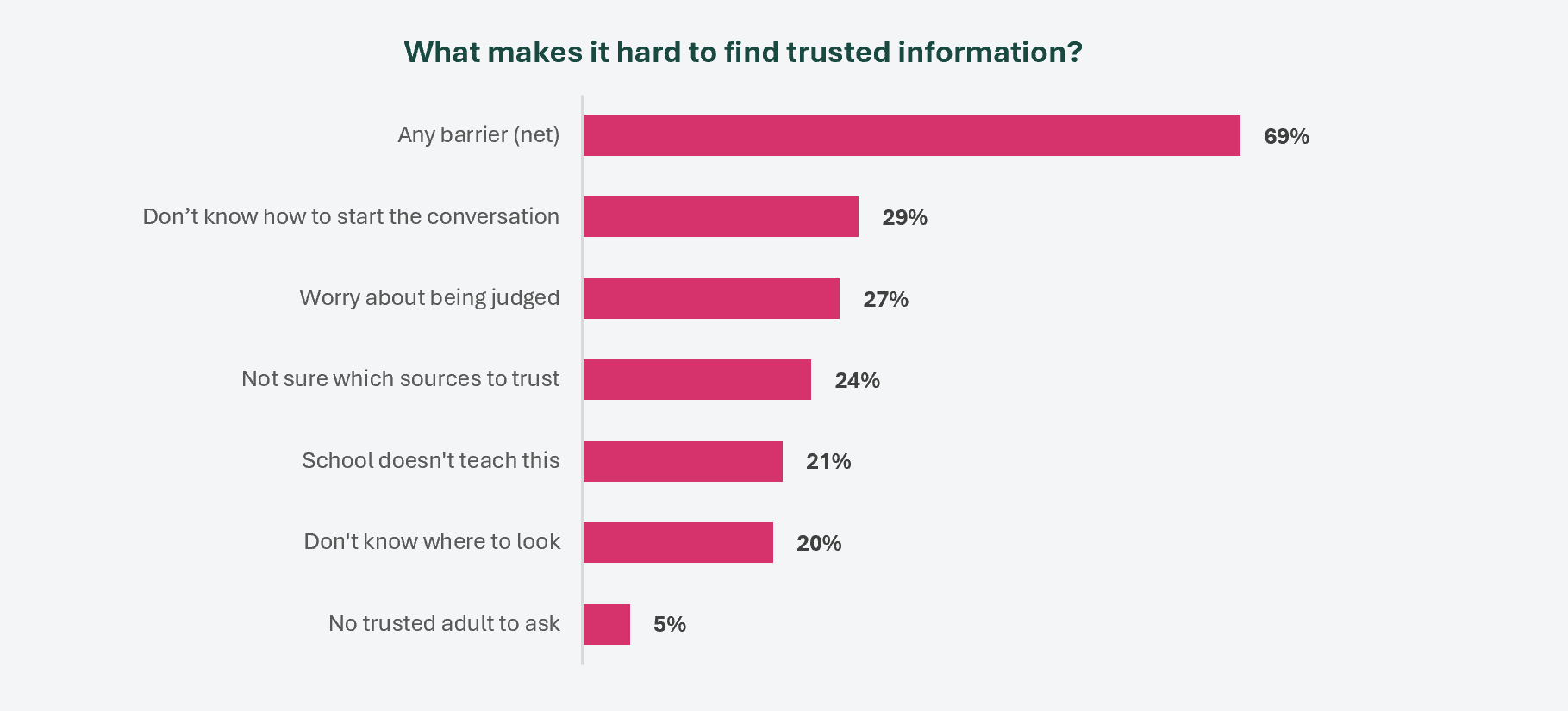
Question 2. “What makes it hard for you to find information about healthy romantic relationships?”
Over two-thirds of teens reported at least one barrier to getting trusted information about healthy relationships.
The most common barriers cited included: not knowing how to start the conversation (29%), fear of judgment (27%), and not knowing which sources to trust (24%).
Only 5% of teens reported they did not have a trusted adult to ask about healthy romantic relationships. This was higher among females (7%), Black youth (13%), low income youth (9%), and youth living in the South (7%).
Notably, “not sure which sources to trust” is significantly higher among females at 29% compared to males at 19%, which suggests a real gender gap with this specific barrier.
Next, we wanted to gauge youth’s likelihood of using an app to learn about healthy relationships and their preferences for learning about it.
Question 3. “How likely are you to use an app to learn about healthy romantic relationships?”
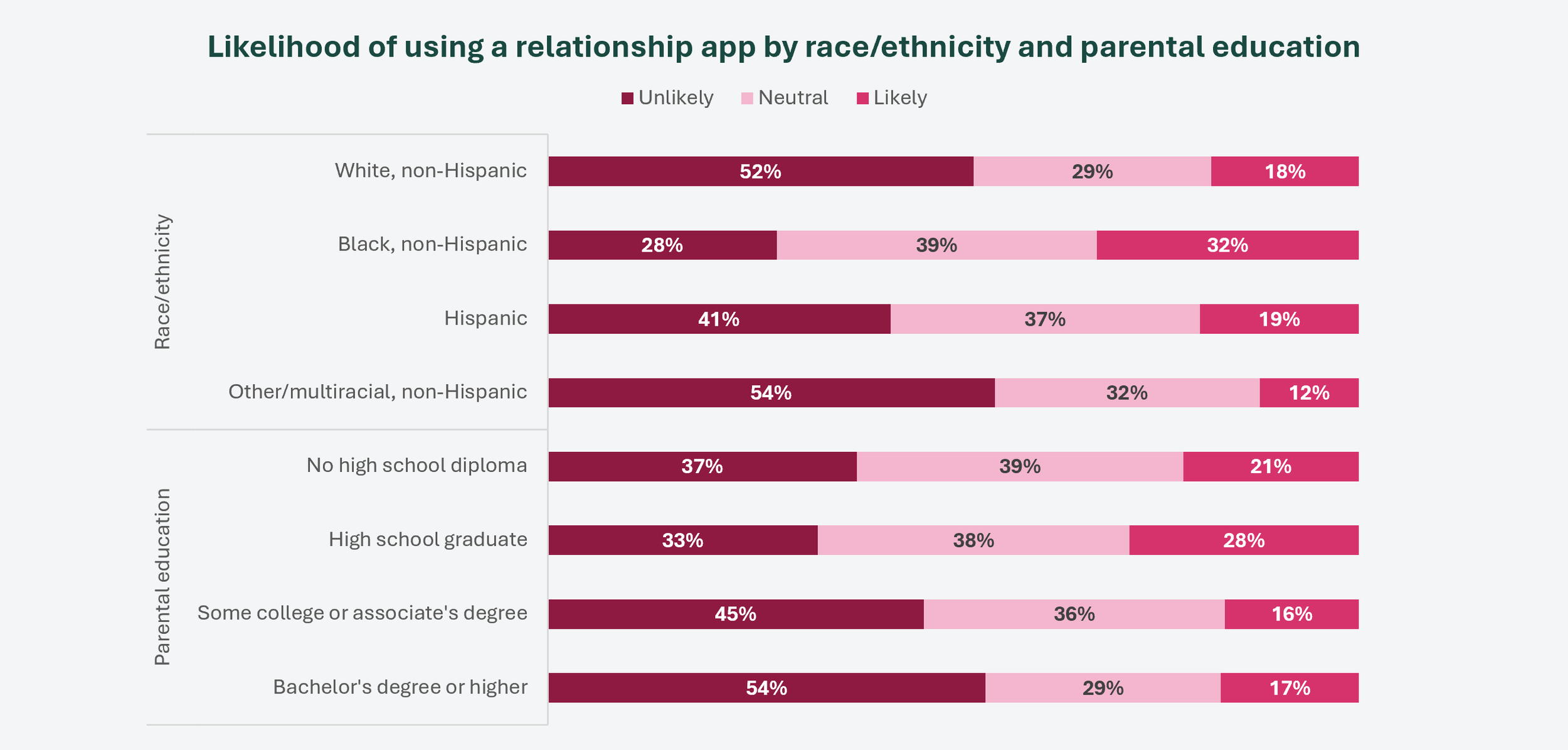
The majority of teens (46%) said they were “unlikely” to use an app to learn about healthy romantic relationships. 33% were “neutral” and only 19% were “likely.”
Of those who said they were “likely” to use an app, 21% were 15-17 years old, 28% had parents with a high school diploma, 32% were Black, and 26% were low income.
Unlikeliness was highest among youth whose parents had a bachelor’s degree or higher (54%), lived in high income households (57%), White teens (52%), and those who lived in the West* (53%).
Question 4. “How would you want to learn about an app that helps with healthy romantic relationships?”
The majority of teens reported their preferred way to learn about an app was from people they know and trust. 51% said they would want to learn about it via a trusted adult such as a parent, coach, or mentor, and 40% said they would want to learn about it from friends or peers.
School-based promotion was less preferred with only 18% of teens choosing this option.
The final question we asked teens was to understand which features of an app would be appealing to potential users.
Question 5. “If there was an app that taught about healthy romantic relationships, which feature(s) would be important to you?”
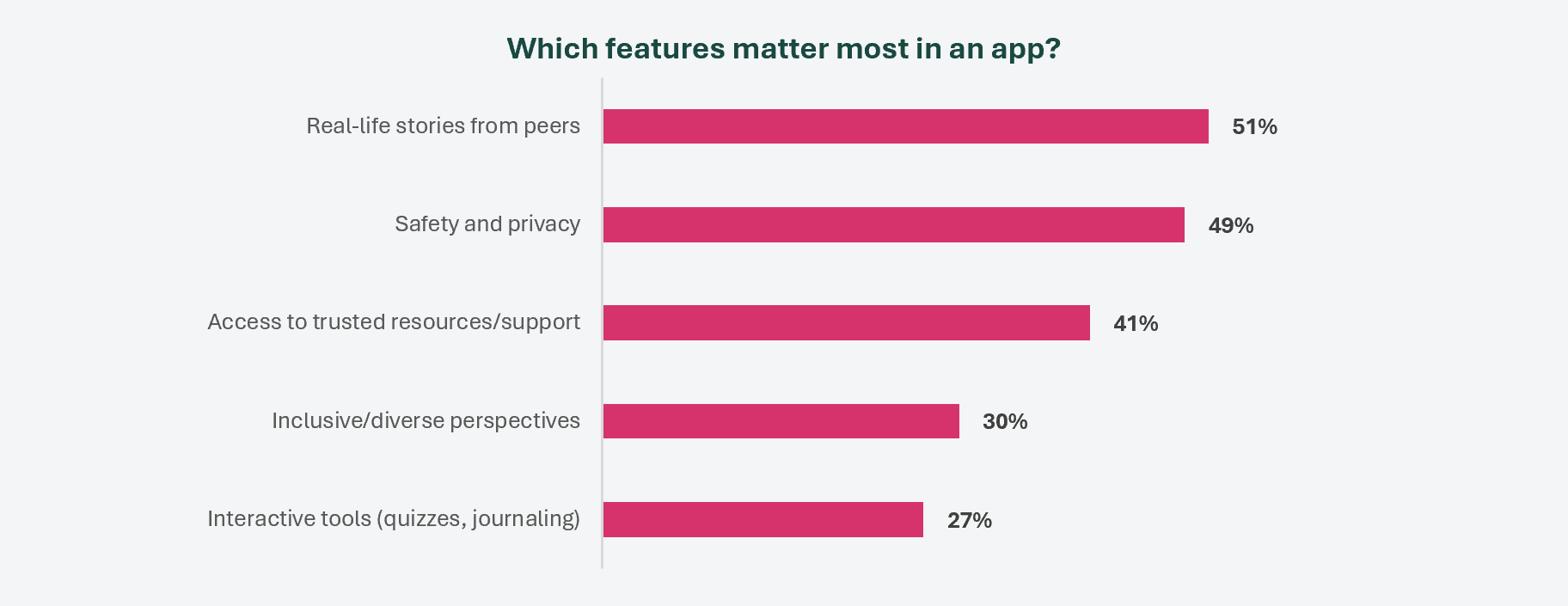
51% of all teens indicated real-life stories from peers was an important feature. This feature was rated highest by Black teens (62%), followed by White teens (50%), and Hispanic teens (45%).
Overall, 49% of youth reported safety and privacy as an important feature. This was cited by 53% of White teens, 45% of Hispanic teens, and 56% of teens in higher-income households.
How do these findings compare to what we know about SafeSpace users?
These nationally representative findings echo what we’ve heard directly from SafeSpace users:
SafeSpace’s real-life stories offer young people an enjoyable opportunity to learn about healthy romantic relationships from their peers.
“I really enjoyed the stories. It was a different way of showing examples of different things. The story seemed like stuff that has happened around me, to my friends or family.”
Our users widely value the privacy and safety that SafeSpace provides, particularly when seeking information about healthy romantic relationships.
“I think with the app it does actually feel really safe for me to be looking through these things, reading these stories. I felt really seen, I felt really understood.”
Our users also say that not knowing how to start the conversation with a trusted adult is a major barrier to establishing healthy romantic relationships.
“[I would like to learn about] maintaining or ending potentially difficult relationships. Something about difficult conversations, how to talk about certain topics with friends or with a trusted adult, tips and tricks for having these conversations.”
Lastly, it is important to our users to be able to find trusted, medically accurate resources on topics related to healthy romantic relationships, which was identified as a challenge.
“Most of those things I did have to find out on my own through unrestricted internet access, and that wasn't pretty. I would have appreciated having a reliable source that wouldn't have led me to be looking at things that I didn't have to look at.”
One area that was notably different between our SafeSpace users and the youth respondents from the Teen Omnibus survey was related to the role and presence of trusted adults in their lives. Whereas the Teen Omnibus respondents overwhelmingly reported going to a parent/caregiver for information on healthy romantic relationships, this was not as common for current SafeSpace users. Instead, SafeSpace users often indicated that they did not have trusted adults who they could turn to for support with these topics.
What does this mean for SafeSpace?
These findings have several key implications for our team as we work to make SafeSpace available to youth across the nation.
First, while our social media-based campaign was highly successful for this intervention and enabled us to reach over 1,000 youth, these findings suggest opportunities to strengthen our reach by connecting with teens through their parents and other trusted adults outside of school settings. Building connections with young people through trusted adults can aid us in showcasing the value of SafeSpace, especially for those who may be less likely to want to use an app on their own. As our users have shared, SafeSpace provides teens with the privacy to learn about healthy romantic relationships and identify trusted, medically accurate information. But, there is room for us to grow here as well. One such area that youth repeatedly indicated was the need for more tools to help them start difficult or uncomfortable conversations about romantic relationships with parents and caregivers. We look forward to exploring how to do this in a way that will be beneficial for teens.
Second, the importance of real-life peer stories for teens discussing healthy relationships remains clear, further highlighting the opportunity for MyHealthEd to support youth health and wellbeing through storytelling and technology. Both teens from the survey and our users cited real-life stories as a key feature that is appealing to learn about healthy romantic relationships. This is something we are pleased to see is still reaching young people and encourages us in continuing with our mission to share authentic stories from teens.
Finally, the differences we observed in teens' responses by socioeconomic status shed light on new ways we can reach teens from various backgrounds. Youth have different needs, interests, and preferences, and these results highlight areas for us to focus on as we develop our outreach strategies. SafeSpace can be pivotal for teens who report having fewer alternative trusted resources for information about healthy romantic relationships, both online and in person.
Working with NORC and the AmeriSpeaks Teen Omnibus Survey team was a valuable experience and we are grateful for the opportunity to partner with them to gather feedback from teens across the country. We will certainly take the information learned from them into consideration as we complete our evaluation of SafeSpace and begin sharing the app with communities as an evidence-informed program to support youth in learning about healthy romantic relationships.
Ci’erra, Marisa, & Brittany
P.S. There are lots of ways to support our work further – whether through financial support or partnering with us to bring SafeSpace to teens in your community. Email us with any inquiries at hello@myhealthed.org.
*The AmeriSpeak Teen Omnibus Survey uses regional strata defined using the standard four US Census Bureau regions: Northeast (CT, ME, MA, NH, RI, VT, NJ, NY, and PA), Midwest (IL, IN, MI, OH, WI, IA, KS, MN, MO, NE, ND, and SD), South (DE, FL, GA, MD, NC, SC, VA, DC, WV, AL, KY, MS, TN, AR, LA, OK, and TX) and West (AZ, CO, ID, MT, NV, NM, UT, WY, AK, CA, HI, OR, and WA).